Audio focus loss is not proof of silence
A navigation prompt interrupts music. The focus log looks correct, but it cannot tell you what reached the driver's seat. An AAOS review needs separate evidence for policy, player behavior and output.
Yahagu Research · Published 2026-09-29 · Sources checked 2026-09-29 · 5 min read
AAOS audio-focus and Audio Control HAL documentation, with Android media API references checked on 29 September 2026. System-enforced fade is discussed within its Android 15 and OEM-configuration scope.
The prompt finishes. What should the music do?
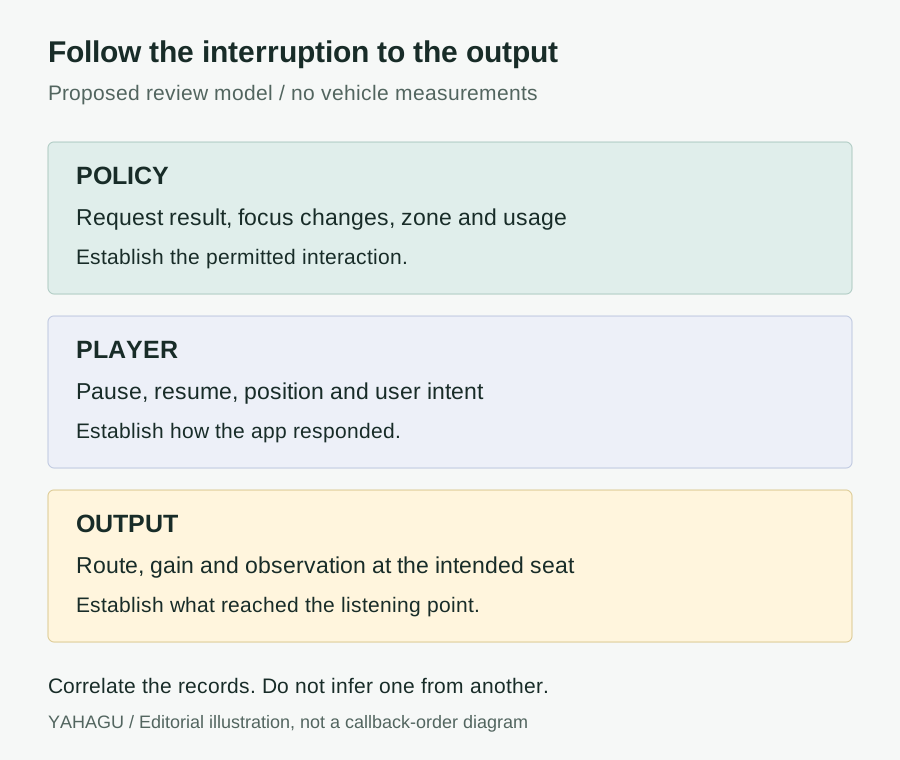
Imagine reviewing a music app while a navigation prompt plays. The intended experience is simple: the driver hears the direction, then the music returns at its previous level. During the prompt, however, the app might pause, continue at reduced gain, or keep playing behind a system fade. A focus log alone cannot distinguish those outcomes.
This is a proposed integration scenario, not a report of a defect in a car. My recommendation is to review the policy decision, the player response and the output separately. Correlate their timestamps, but do not promote a callback into proof that a speaker became quiet.
Start by writing down the intended behavior for this interruption. Music can often tolerate reduced volume; spoken material may lose meaning when two voices overlap. Decide whether this product should pause or duck before judging a trace. Otherwise, two teams can agree that focus handling works while expecting different listening experiences.
The app's request describes an intention
AudioFocusRequest.Builder lets an app supply audio attributes, a focus-change listener and its preference to pause when ducked. setWillPauseWhenDucked(true) requires a listener; it declares how the app intends to respond. It does not implement the player's pause operation. [2]
For the proposed review, capture both the incoming event and the player action it triggers. A log entry at the listener's first line establishes receipt. A later player-state observation provides different evidence. Keep the original user request as well: a pause caused by an interruption should not erase a subsequent pause chosen by the user.
Delayed focus deserves its own state. AudioManager defines AUDIOFOCUS_REQUEST_DELAYED as a request that has not yet received its grant. Treating it like AUDIOFOCUS_REQUEST_GRANTED would start from the wrong premise. [3] In the UI, distinguish waiting to play from a failed request. If the user cancels while waiting, a later gain should not revive an intention that the user has withdrawn. That cancellation rule is a product recommendation, not a claim that Android maintains your app's intent state.
Concurrent focus still leaves a mixing problem
AAOS supports exclusive, rejected and concurrent interactions. Concurrent focus has specific prerequisites, including the incoming transient-may-duck request and the existing holder's ducking preferences. AOSP recommends separate output devices for streams that need independent downstream handling; mixing them together first limits that control. [1]
The Audio Control HAL documentation describes ducking notifications by zone and output-device address, with the usages holding focus. OEMs enable this path through audioUseHalDuckingSignals and implement the corresponding HAL behavior. Multiple usages can map to one device, which is why the active-usage information matters. [4]
For a navigation-over-music review, record the actual route mapping before blaming the app. If both streams share a path that cannot attenuate them independently at the relevant stage, a correct policy decision will not by itself produce the desired mix. This is a diagnostic possibility to inspect, not a finding about every shared route.
Choose the listening point deliberately. A recording at a digital tap answers a different question from a measurement near the driver's seat. Neither automatically describes a passenger zone. Keep the route, gain settings and observation location with the result so another reviewer can reproduce the same question.
Android 15 does not settle the configuration question
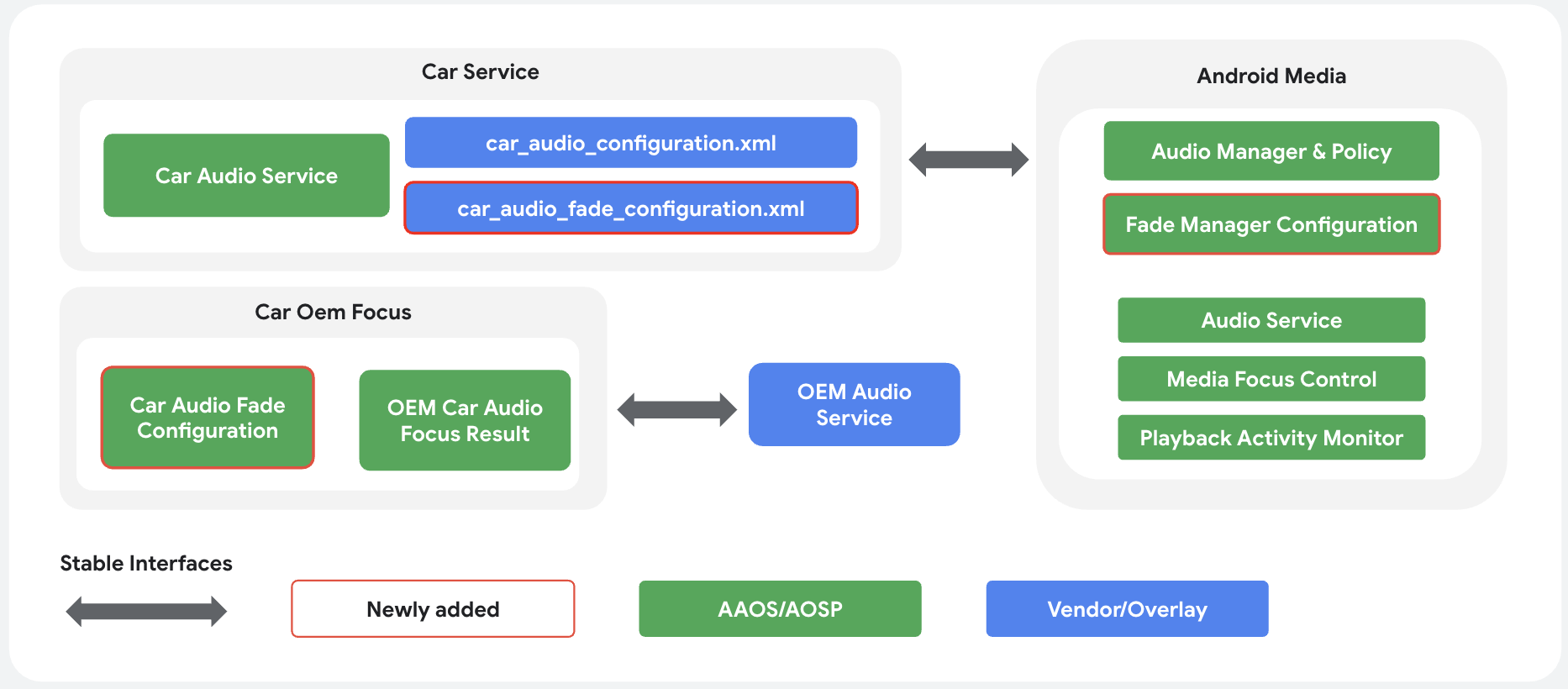
AOSP documents system-enforced fade for AAOS in Android 15. It uses OEM-defined rules to target eligible playback after focus loss. The audioUseFadeManagerConfiguration flag is disabled by default; enabling it and providing applicable configuration are separate from knowing the Android version. [1]
Ask the platform owner for the enabled configuration and the rule that covers the stream under review. Then test the intended behavior on that build. A version label, a configuration file found in a source tree, or a quiet speaker on one attempt does not establish that the expected rule ran.
Keep system intervention distinct from app cooperation. A system fade can reduce output while the player continues advancing. For an audiobook, restoring volume at a later position may mean the listener missed words. An app pause can preserve the position, but its resume behavior still needs review. These outcomes may sound equally quiet during the interruption and feel quite different afterward.
Read the evidence without overclaiming
These are proposed judgments for an integration review, not test results. Their purpose is to prevent a passing observation at one layer from hiding an unexamined outcome at another.
| Observation | Supported conclusion | Still needs checking |
|---|---|---|
| Focus-loss callback logged | The app received a notification. | Player response and output at the intended listening point. |
| Request result is DELAYED | Focus has not yet been granted. | Waiting state, cancellation and handling of a later gain. |
| Concurrent focus granted | Policy permits the interaction. | Actual routing, independent gain control and audible mix. |
| Build reports Android 15 | The documented fade feature is relevant to inspect. | Enabled OEM flag and rules applicable to this stream. |
| Music is inaudible during the prompt | That observation point has no audible music. | Whether pause, fade, mute or routing produced the result. |
| Focus returns after the user pressed Pause | The focus state changed again. | The app retains the user's decision instead of auto-resuming. |
Include recovery in the acceptance result
An interruption review should finish after the prompt, not at its loudest moment. Check the return level, playback position and behavior when the user intervenes. Retain the evidence needed to distinguish app recovery from a change in system gain. Avoid a single success flag whose meaning differs between the app, audio and HMI teams.
For this scenario, I would accept the integration only when the chosen pause-or-duck behavior reaches the intended output and recovery respects the user's latest action. Set product-specific timing and audibility criteria with the responsible teams; this documentation analysis supplies neither safety thresholds nor a vehicle certification.
The official architecture image is reproduced without modification from work created and shared by the Android Open Source Project. AOSP's content-license page specifies Apache 2.0 for documentation and Creative Commons Attribution 4.0 for other site content, and requests image attribution. The separate observation diagram is original Yahagu work. [5]
Open questions
- Product
- Should this content pause or duck during the chosen interruption?
- Integration
- Which enabled configuration and output route apply to this stream?
- Validation
- Does recovery preserve playback context and the user's latest action?
Sources & scope
The interruption scenario and review outcomes are proposals, not vehicle or emulator measurements. This article does not certify warning audibility or describe a particular manufacturer's implementation.
- AAOS audio focus and system-enforced fadeEnglish original · Checked 29 September 2026
- AudioFocusRequest.BuilderEnglish original · Checked 29 September 2026
- AudioManager focus request resultsEnglish original · Checked 29 September 2026
- Audio Control HAL: ducking and output devicesEnglish original · Checked 29 September 2026
- AOSP content license and image attributionEnglish original · Checked 29 September 2026
What would you add?
Share a different implementation, flag a correction, or tell us where this analysis helps with your work. A public source link is welcome.
Your message and email are stored privately for handling this request. Do not include confidential product information.
Related analysis
 01
01A readable temperature is not a successful climate command
A climate control can show a valid temperature and still fail to change it. For an AAOS integration, the useful distinction is between the reported target, the pending request and the temperature the system measures.
 02
02Passenger displays need their own restriction contract
A passenger video experience cannot rely on one vehicle-wide moving flag. AAOS separates display restrictions, activity blocking and supported background audio. Here is how those boundaries change an integration review.
 03
03Physical buttons still need a state model
Volkswagen gives climate and audio tasks fixed locations. BMW's announced steering wheel highlights actions as they become available. An interrupted call shows why both hardware and software state belong in the review.
 04
04The LYRIQ supports CarPlay. Which system plans the charging stop?
A charging trip can cross a phone planner, projected maps and built-in navigation. The useful comparison is what each path retains, recalculates and confirms before arrival.
 05
05Car app sign-in: what happens after the phone says done?
The phone approves the account, but the car still needs a result. A review of parked sign-in, delayed authorization and recovery paths that send drivers back to the right task.
 06
06Four screens between a saved place and turn-by-turn navigation
A close reading of Google's navigation example: where a place becomes a route, why a familiar layout still consumes another step, and what Back must preserve.