Choosing when to commit an Android SDV update
A VM can boot successfully while its consumers disagree about a changed service. A worked compatibility example explains what an integrator should verify before committing an Android SDV update.
Yahagu Research · Published 2026-10-13 · Sources checked 2026-10-13 · 5 min read
AOSP SDV Update Manager and SDV Core documentation checked on 12 October 2026. The non-virtual A/B discussion describes the documented configuration, not every OEM build.
The VM boots. Does the feature work?
Suppose a vehicle update changes a service that supplies information to the cockpit. The updated VM boots, but another service can no longer interpret its responses. Calling the update complete at this point would confuse a working boot image with a working feature.
This is an illustrative integration failure, not a reported vehicle defect. Android's SDV Update Manager provides a useful place to examine it: the documented process separates preparation, activation and commitment. The system integrator still supplies the client that coordinates the vehicle update. [1]
My recommendation is to make that client own an explicit commit decision. Before making a supported update permanent, it should obtain the agreed evidence for the affected service dependencies. A screen returning after reboot is useful evidence about that screen. It does not establish that the updated service and its consumers still agree.
Start with the update type

AAOS SDV Core is an Android-based environment for native services. The integration guide distinguishes it from the JVM-based application environment and describes communication between instances. It should not be read as a description of every production infotainment system. [2]
The Update Manager supports system updates and service-bundle updates. A system update uses the inactive system slot; a service-bundle update stages APEX packages. Both require activation across a reboot in the documented workflow, but the payload and completion operations differ. [1]
For a release review, name the unit you are changing. A system image, a service bundle and an external controller's firmware are not interchangeable. The last of these needs its own evidence and update contract; this documentation does not establish its recovery behavior.
A successful activation leaves a decision outstanding
In the documented manager, PREPARE stages the payload. ACTIVATE makes it take effect after reboot. After successful post-reboot verification, ACTIVATE_POST_REBOOT_COMPLETE waits for the client to choose Commit or Rollback. The reported percentage and the manager's state are separate status information. [1]
In the example, the client needs to know which service revision it is evaluating, which consumers must communicate with it and what evidence counts as a pass. A response from one endpoint may establish reachability while leaving a changed data meaning untested. A compatibility probe should exercise the changed contract, not just establish that a process is alive.
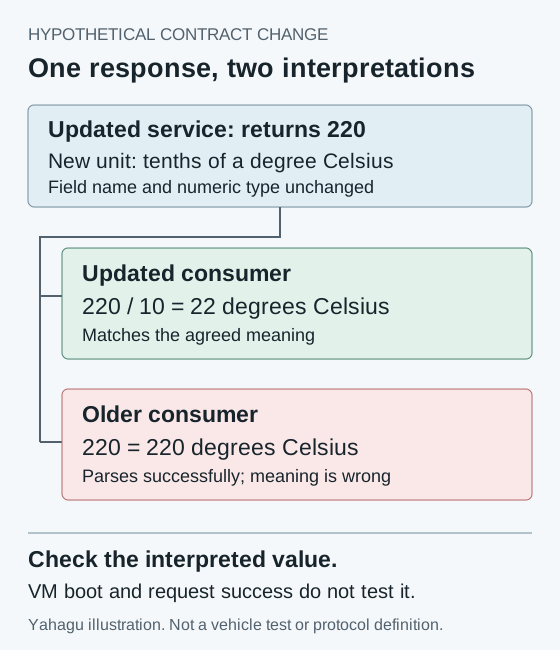
Consider a proposed service revision that changes a numeric response from degrees Celsius to tenths of a degree without changing its field name or type. At 22 degrees, the service now returns 220. An updated consumer converts it to 22; an older consumer treats it as 220. Both may parse the response and report a healthy connection. This deliberately incompatible, hypothetical change shows why a reachability check is insufficient; adding a field alone would not establish such a failure.
For this example, the acceptance probe must check the interpreted value at each affected consumer. A result of 220 at the old consumer fails the agreed contract even when the service and VM remain available. The integrator can preserve the old unit, introduce an explicitly versioned contract, or coordinate the consumer updates. The manager does not select or validate those product decisions.
The SDV system-update guidance makes the same boundary explicit at network level: correctly updating a single system does not guarantee communication across the participating systems. It calls for coordinated deployment or changes that preserve compatibility. [3]
Compare the evidence before committing
The following decisions are proposed review outcomes, not results from a VM or vehicle test.
This distinction also changes the user-facing message. After preparation, “Ready to restart” may fit the product. During acceptance checks, a completion message would be premature. The exact wording depends on whether the user is allowed to interact at that stage, which this platform document does not decide.
| Evidence available | Decision supported | Decision not yet supported |
|---|---|---|
| Payload preparation completed | Proceed to the defined activation stage if its prerequisites hold | Announce that the new service is running |
| Post-reboot activation verified | Evaluate the release-specific acceptance evidence | Assume all dependent services work |
| Updated service answers a request | Confirm that this request path responds | Infer compatibility for other consumers or changed fields |
| A dependent consumer rejects the response | Treat the affected feature as failing acceptance | Commit merely because the VM booted |
| Agreed dependency checks pass | Allow the authorized client to make its commit decision | Claim unrelated controllers have been validated |
| Rollback requested after activation | Follow the documented rollback state and reboot requirement | Tell the user recovery has already completed |
Rollback has a scope and an end
The manager documents a user-data checkpoint around activation. Commit makes the supported update permanent and commits the checkpoint; rollback follows different paths depending on the current state and can require a further reboot. System and service-bundle updates also have different sources for their boot-attempt limits. [1]
Do not turn this into an unlimited undo promise. In particular, do not infer that a change sent to a remote controller, another VM or a cloud service is covered by this VM's checkpoint. List those effects separately. If accepting the update depends on reversing one of them, the release needs an explicit recovery mechanism for that effect.
Nor should the client wait forever for an unbounded set of checks. Define the affected dependencies, the evidence deadline and the failure path before starting. Testing that path matters as much as testing a successful commit: a rejected dependency should leave the operator with a known state, not just a progress screen that stopped changing.
Do not substitute a phone's partition diagram
The SDV system-update guide retrieved on 12 October 2026 describes a non-virtual A/B configuration. This is the documented configuration, not a claim about every OEM build. Android's Virtual A/B overview describes snapshots for dynamic partitions and a later merge, rather than a second physical copy of every dynamic partition. These descriptions belong to different configurations. [3][4]
For this case, the useful conclusion is narrow: identify the target's update mechanism and preserve the distinction between activation and commitment. A familiar Android version number is insufficient evidence for the partition layout, rollback scope or vehicle-wide coordination in a particular build.
The owner of the release should be able to point to the evidence that justified Commit, the components that evidence covered and the recovery path exercised before release. That is a more useful acceptance record than a screenshot of 100 percent.
Open questions
- Product
- Which consumers must interpret the changed service correctly?
- Integration
- What evidence permits the authorized client to commit?
- Validation
- Which side effects and reboot requirements are covered by the recovery path?
Sources & scope
The compatibility failure and acceptance judgments are hypothetical. No vehicle or emulator was tested, and no manufacturer implementation or vehicle-wide rollback capability is established.
- AOSP SDV Update ManagerEnglish original · Checked 12 October 2026
- SDV Core integration guideEnglish original · Checked 12 October 2026
- SDV A/B system updatesEnglish original · Checked 12 October 2026
- Virtual A/B overviewEnglish original · Checked 12 October 2026
- AOSP content licenseEnglish original · Checked 12 October 2026
What would you add?
Share a different implementation, flag a correction, or tell us where this analysis helps with your work. A public source link is welcome.
Your message and email are stored privately for handling this request. Do not include confidential product information.
Related analysis
 01
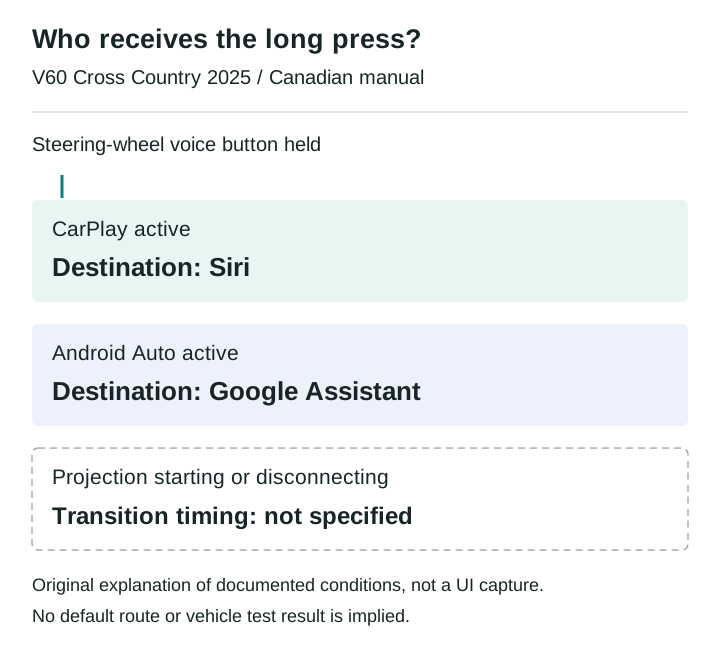
Which assistant owns the steering-wheel voice button?
The Canadian 2025 V60 Cross Country manual assigns the same long press to different phone assistants. A disconnect scenario shows what an integration test must record before judging media commands.
 02
Audio focus loss is not proof of silence
A navigation prompt interrupts music. The focus log looks correct, but it cannot tell you what reached the driver's seat. An AAOS review needs separate evidence for policy, player behavior and output.
 03
A readable temperature is not a successful climate command
A climate control can show a valid temperature and still fail to change it. For an AAOS integration, the useful distinction is between the reported target, the pending request and the temperature the system measures.
 04
Passenger displays need their own restriction contract
A passenger video experience cannot rely on one vehicle-wide moving flag. AAOS separates display restrictions, activity blocking and supported background audio. Here is how those boundaries change an integration review.
 05
Physical buttons still need a state model
Volkswagen gives climate and audio tasks fixed locations. BMW's announced steering wheel highlights actions as they become available. An interrupted call shows why both hardware and software state belong in the review.
 06
The LYRIQ supports CarPlay. Which system plans the charging stop?
A charging trip can cross a phone planner, projected maps and built-in navigation. The useful comparison is what each path retains, recalculates and confirms before arrival.
 07
Car app sign-in: what happens after the phone says done?
The phone approves the account, but the car still needs a result. A review of parked sign-in, delayed authorization and recovery paths that send drivers back to the right task.
 08
Four screens between a saved place and turn-by-turn navigation
A close reading of Google's navigation example: where a place becomes a route, why a familiar layout still consumes another step, and what Back must preserve.