Which assistant owns the steering-wheel voice button?
The Canadian 2025 V60 Cross Country manual assigns the same long press to different phone assistants. A disconnect scenario shows what an integration test must record before judging media commands.
Yahagu Research · Published 2026-10-20 · Sources checked 2026-10-20 · 4 min read
Canadian V60 Cross Country 2025 support documentation checked on 20 October 2026. Documentation revision dates do not identify an individual vehicle software version.
The same button can reach a different assistant
Connect an iPhone to a car, open CarPlay, and hold the steering-wheel voice button. The button still belongs to the car. The assistant answering the request can belong to the phone.
Volvo makes that distinction in its Canadian V60 Cross Country 2025 manual: with CarPlay active, a long press invokes Siri instead of the vehicle's built-in assistant. Its Android Auto instructions assign a long press to Google Assistant while Android Auto is active. These are two documented destinations for the same physical control under different conditions. [1][2]
For a cockpit integration team, the useful acceptance criterion is whether the intended assistant receives the request in the current connection state. Hearing a listening tone establishes much less. A test must identify the responding assistant before it judges the command that follows.
This is a reading of Volvo's Canadian support documentation, checked on 19 October 2026, not a vehicle test. The Android Auto page was updated on 22 July 2026; the CarPlay page on 1 August 2025. Those dates describe documentation revisions. They do not establish which software an individual vehicle has installed.
Three routes, with different evidence
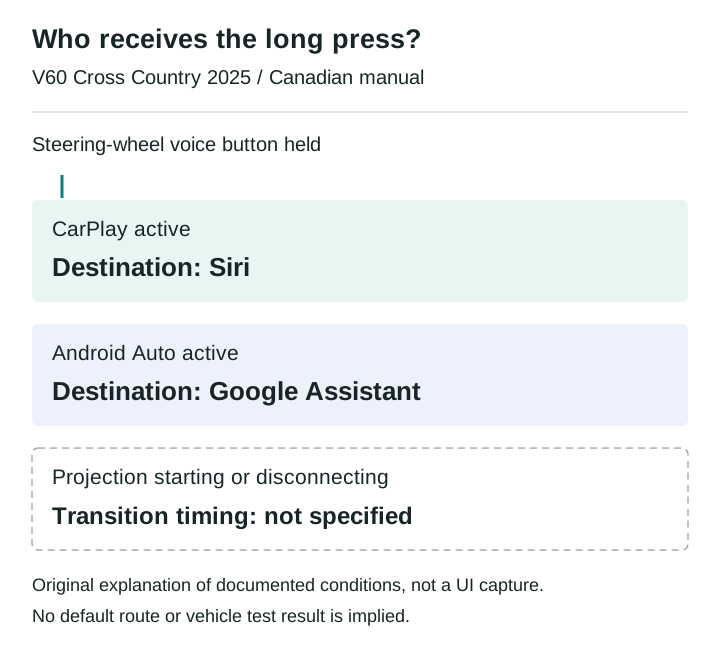
The built-in voice-control documentation describes an assistant that handles media, phone, navigation and climate tasks. It also warns that availability and behavior can change with region and over time, and that connectivity can limit functions. It supplies no command-by-command guarantee for every installed media service. [3]
The two phone-projection pages are more specific about the button:
The last row is a gap in the cited instructions, not evidence of a defect. A team still needs an explicit product decision for that state.
Both projection pages retain access to the vehicle's own interface through bars around the projection view. A driver therefore has more context than a binary “phone connected” flag. An integration test should distinguish a paired phone, an active projection session and the interface currently visible. The manual ties the long-press behavior to active projection; Bluetooth pairing alone is not the stated condition. [1][2]
The separate Bluetooth instructions allow several saved pairings but describe only one connected phone at a time. That is a Bluetooth connection rule, not an arbitration rule for two simultaneous projection sessions. Record the active transport and session rather than inferring them from the saved-device list. [4]
The steering-wheel controls page also identifies voice control among the right-hand controls and says that button functions depend on context. That overview locates the input; the projection-specific pages establish the long-press destination. A test specification needs both levels of detail. [5]
| Observed state | Documented voice entry | Verify on the vehicle |
|---|---|---|
| CarPlay active | Hold voice button to invoke Siri | Intended phone responds; app supports action |
| Android Auto active | Hold voice button to invoke Google Assistant | Active phone session receives request |
| Built-in assistant in use | Several categories of vehicle task supported | Action, software, region and connectivity |
| Projection starting or disconnecting | No transition timing contract in cited pages | Handling of the in-progress gesture |
A disconnect during a long press
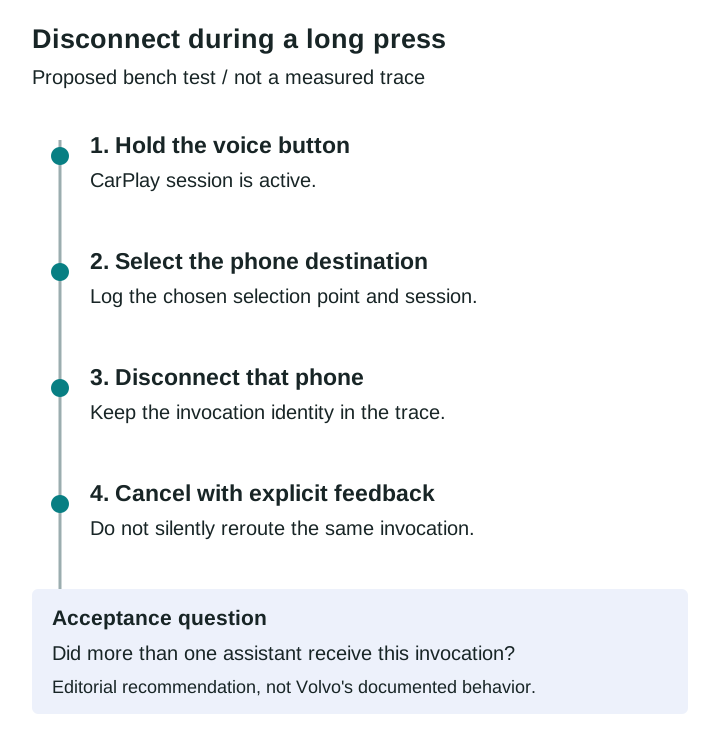
Consider a proposed bench test: start with CarPlay active, begin holding the voice button, then disconnect the phone before releasing it. This scenario is hypothetical. Volvo's cited pages do not specify what the vehicle does.
A team could route the gesture according to the state at button-down, at the long-press threshold, or at release. Each choice requires different recovery behavior. If the implementation selects the phone at the threshold and that session disappears, forwarding the same request to the built-in assistant could give the driver a different service than the one they invoked.
My proposed rule is to select a destination once per invocation and cancel with explicit feedback when that destination becomes unavailable. The feedback must work without requiring the driver to read a screen; its exact sound or wording needs a separate usability review. Let the driver start a new invocation after the system communicates the changed connection state. This adds an interruption, but avoids a silent handover to another assistant. It is a design recommendation, not a description of Volvo's implementation.
For that test, record the press and release times, projection-session changes, selected destination and first visible or audible response. Then check whether one invocation reached more than one assistant. A generic “voice succeeded” result would conceal that distinction.
Separate routing from media execution
After confirming the destination, test the requested action. Opening a media app, resuming playback and selecting a named channel are different operations. A successful first operation does not establish support for the others.
That separation also limits what an engineer can conclude from a driver report. If a driver hears an acknowledgement but the channel does not change, several parts of the transaction remain unobserved: which assistant responded, which player received the request, and whether that player supports the requested selection. The acknowledgement alone cannot locate the failure.
Keep the two acceptance records separate: one for reaching the intended assistant, another for the resulting media state. Add the exact car and phone software versions to both. That gives a regression team a reproducible boundary when a phone update changes behavior without changing the steering-wheel hardware.
Open questions
- Session
- Which transport and projection session were active at selection?
- Invocation
- Did one invocation reach more than one assistant?
- Outcome
- Did the intended media state change after routing succeeded?
Sources & scope
No vehicle test. Disconnect handling is a proposed acceptance rule, not a verified Volvo implementation. Media-command support and the inactive-projection route are not established.
- Volvo: Apple CarPlay, V60 Cross Country 2025, CanadaEnglish original · Checked 20 October 2026
- Volvo: Android Auto, V60 Cross Country 2025, CanadaEnglish original · Checked 20 October 2026
- Volvo: Voice control, V60 Cross Country 2025, CanadaEnglish original · Checked 20 October 2026
- Volvo: Connecting your phone to the vehicle, V60 Cross Country 2025, CanadaEnglish original · Checked 20 October 2026
- Volvo: Steering wheel controls, V60 Cross Country 2025, CanadaEnglish original · Checked 20 October 2026
What would you add?
Share a different implementation, flag a correction, or tell us where this analysis helps with your work. A public source link is welcome.
Your message and email are stored privately for handling this request. Do not include confidential product information.
Related analysis
 01
Choosing when to commit an Android SDV update
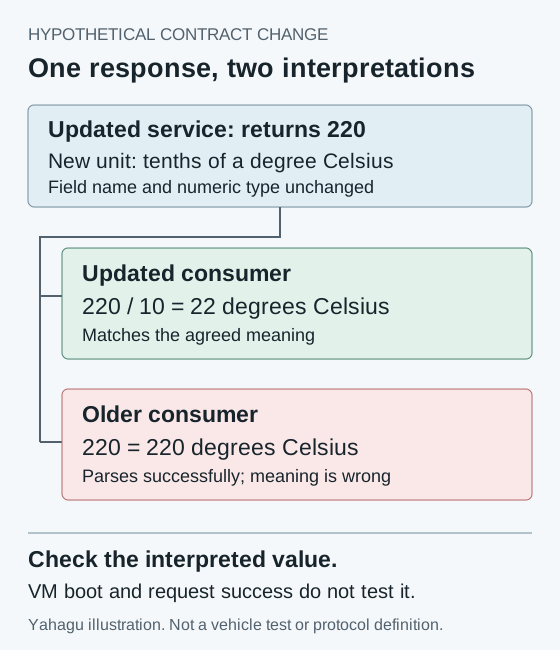
A VM can boot successfully while its consumers disagree about a changed service. A worked compatibility example explains what an integrator should verify before committing an Android SDV update.
 02
Audio focus loss is not proof of silence
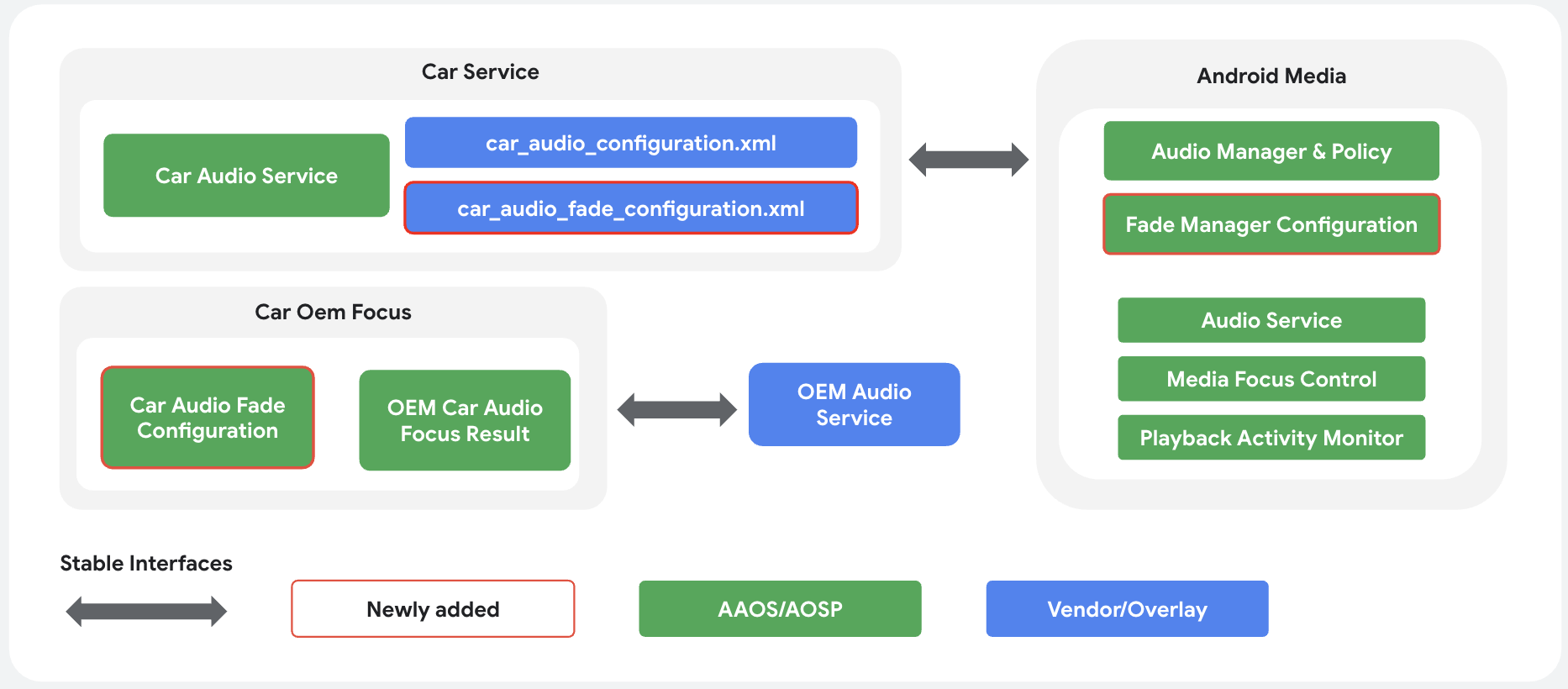
A navigation prompt interrupts music. The focus log looks correct, but it cannot tell you what reached the driver's seat. An AAOS review needs separate evidence for policy, player behavior and output.
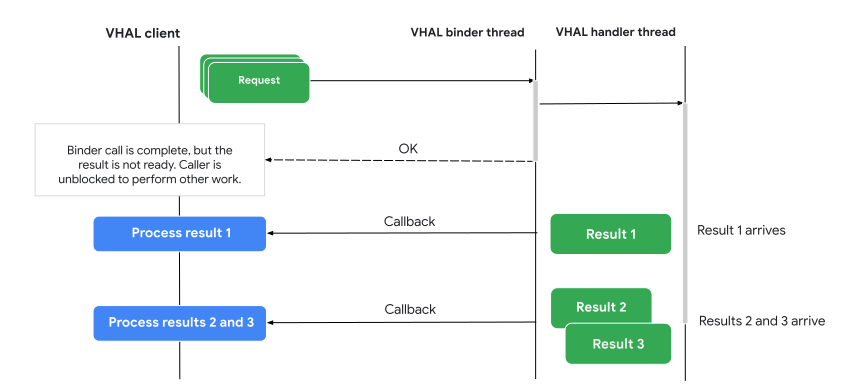 03
A readable temperature is not a successful climate command
A climate control can show a valid temperature and still fail to change it. For an AAOS integration, the useful distinction is between the reported target, the pending request and the temperature the system measures.
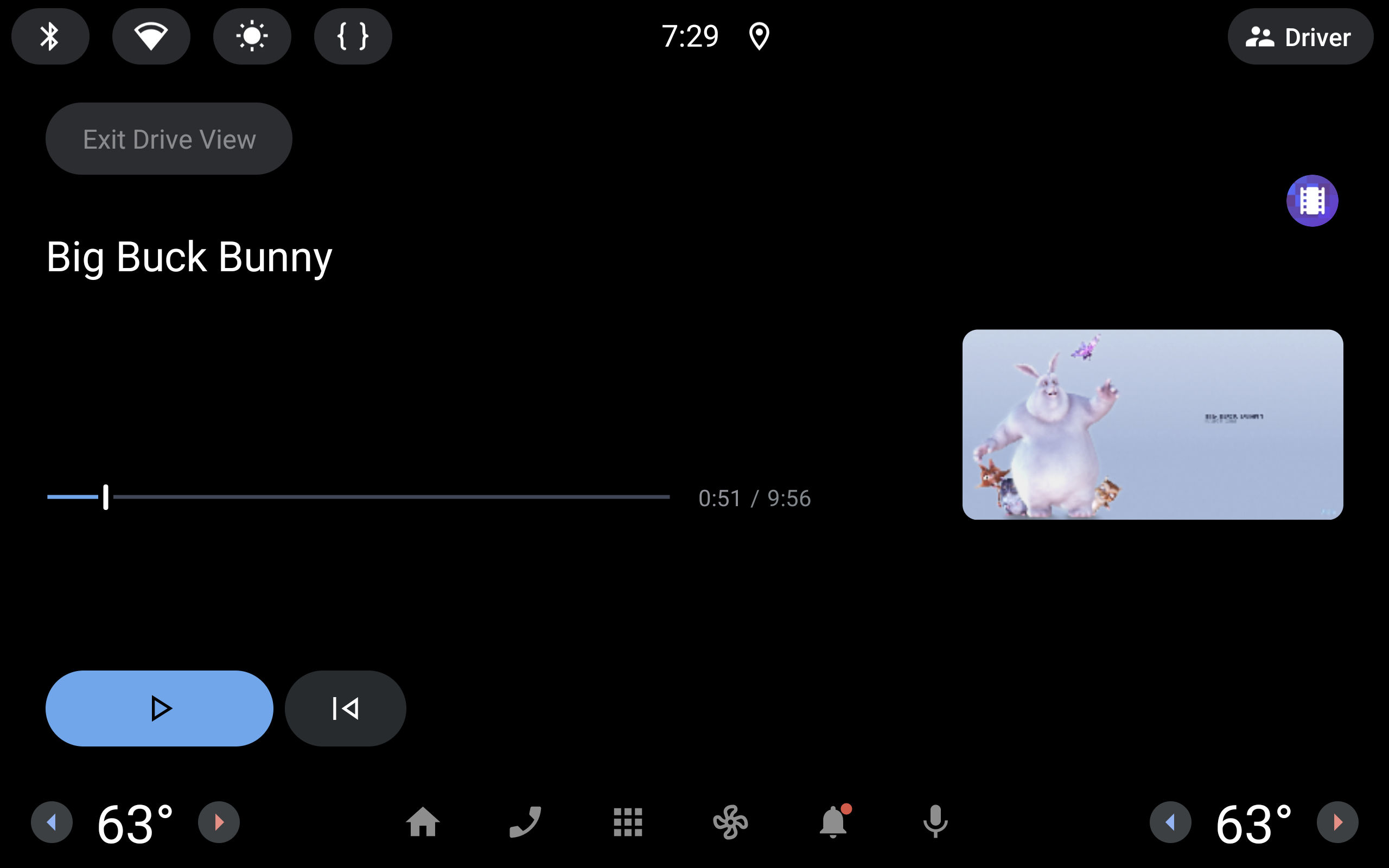 04
Passenger displays need their own restriction contract
A passenger video experience cannot rely on one vehicle-wide moving flag. AAOS separates display restrictions, activity blocking and supported background audio. Here is how those boundaries change an integration review.
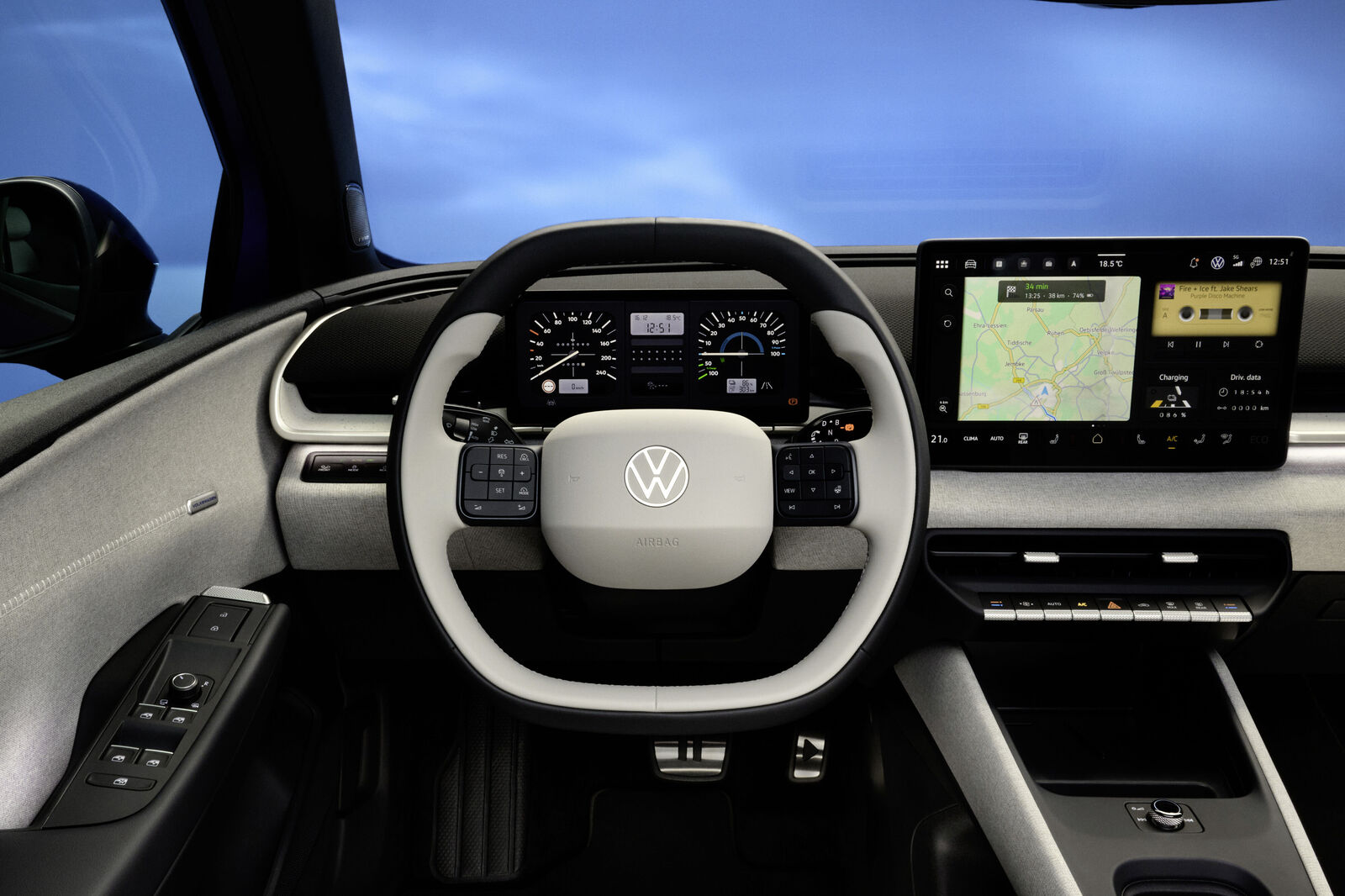 05
Physical buttons still need a state model
Volkswagen gives climate and audio tasks fixed locations. BMW's announced steering wheel highlights actions as they become available. An interrupted call shows why both hardware and software state belong in the review.
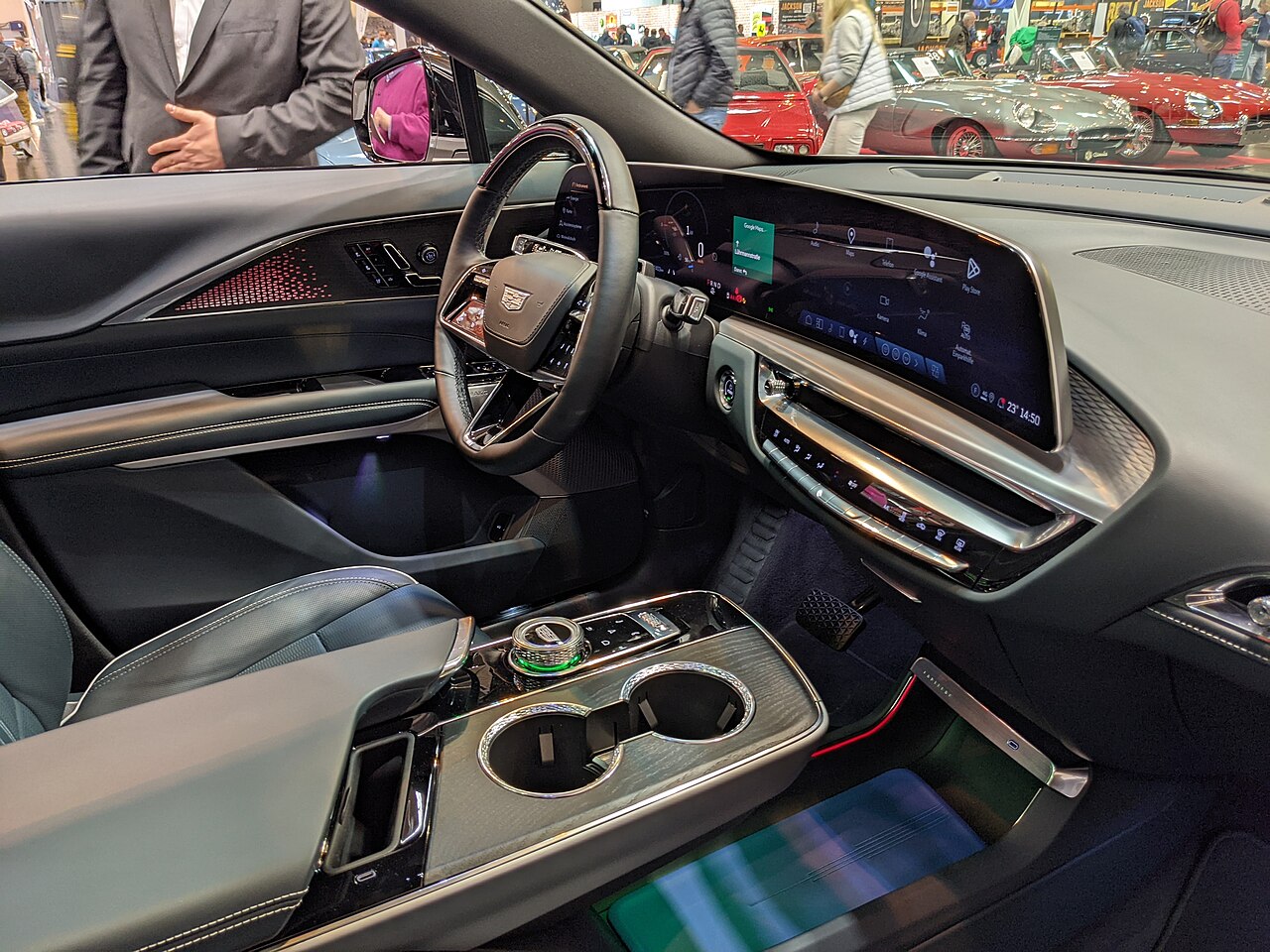 06
The LYRIQ supports CarPlay. Which system plans the charging stop?
A charging trip can cross a phone planner, projected maps and built-in navigation. The useful comparison is what each path retains, recalculates and confirms before arrival.
 07
Car app sign-in: what happens after the phone says done?
The phone approves the account, but the car still needs a result. A review of parked sign-in, delayed authorization and recovery paths that send drivers back to the right task.
 08
Four screens between a saved place and turn-by-turn navigation
A close reading of Google's navigation example: where a place becomes a route, why a familiar layout still consumes another step, and what Back must preserve.