Why a parked car can still miss a background refresh
Garage Mode supplies an idle work window, not proof that a user's content refreshed. Compare job registration, user-data access, execution and the version available after an interruption.
Yahagu Research · Published 2026-10-23 · Sources checked 2026-10-23 · 4 min read
AOSP and Android API documentation checked on 22 October 2026. A hypothetical personalized application-data refresh, not a firmware update or a verified OEM implementation.
An overnight refresh that did not arrive
A driver parks overnight and returns to yesterday's downloaded content. The application had queued a refresh before shutdown. An integration report says Garage Mode ran. Those observations leave a useful question unanswered: did the refresh job start for the intended user, with its own requirements satisfied?
This is a hypothetical application-data refresh, not a vehicle fault report or a firmware update. The analysis uses AOSP and Android API documentation checked on 22 October 2026. No vehicle or emulator was tested. It is a diagnostic comparison based on documentation, not a verified implementation trace for an Android release. Identify the OEM's power configuration and Android build before applying these checks.
The vehicle supplies a window
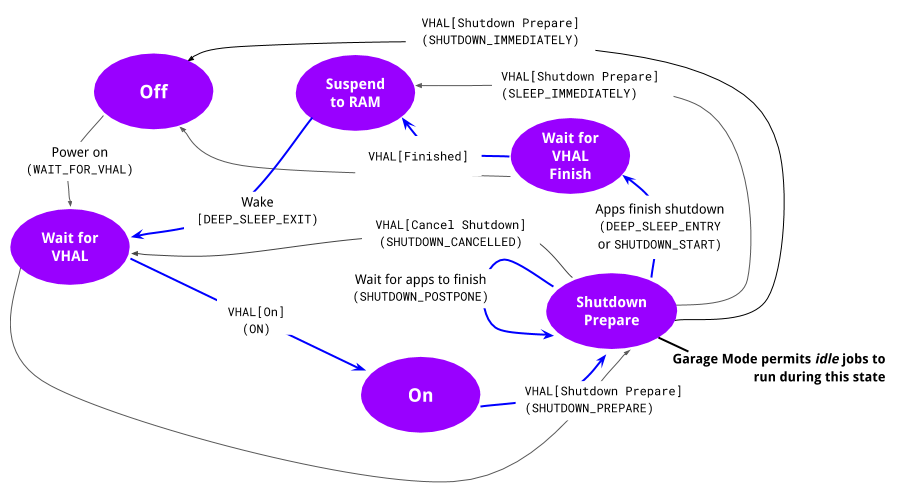
Garage Mode gives idle-constrained jobs time to execute while the Android system stays powered and the display is off. Applications use JobScheduler; they do not directly control this mode. The documented VHAL shutdown preparation distinguishes an allowed work window from an immediate sleep or shutdown request. The framework can request postponement, but the window is bounded and can end early in specified circumstances, such as insufficient battery capacity. [1]
The highlighted state in this diagram tells an integrator where idle work can run. It does not identify the outcome of an individual download. For the overnight example, retain the job identifier and user identifier in the test record. A power-state trace without a matching application record cannot explain why that user's content stayed old.
The user supplies another condition
The AAOS user-system guidance describes a running, unlocked background user as a prerequisite for that user's jobs. For this example, the refresh needs personalized data in credential-encrypted storage, which becomes accessible after unlocking. Verify that storage requirement and the intended user's state on the target build; this example does not cover a service designed to operate before unlock. [2]
That changes the experiment. Compare two runs with the same application data and network: one after the intended user has unlocked, another after a cold boot without that unlock. Keep the intended user's state in the evidence for each run; observing that a different driver can use the display does not establish access to this user's data.
For a personalized refresh, I would leave the old content visibly dated until the application confirms a new valid version. I would not remove the unlock dependency merely to make an overnight test pass. Moving personal data into storage available before unlock is a separate privacy and architecture decision, not a scheduling workaround.
A registered job needs its own configuration
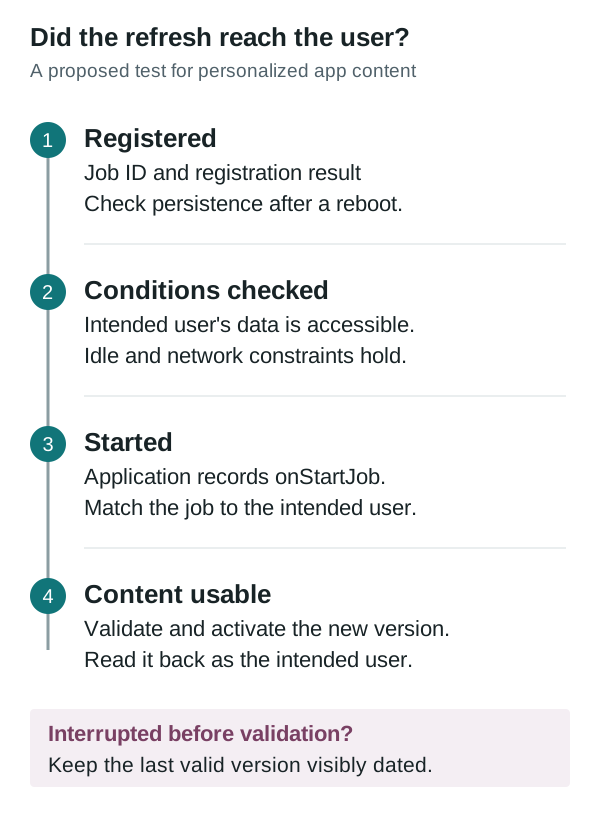
setRequiresDeviceIdle(true) restricts interactive-use execution. It does not mean the same thing as Android Doze. A job can have a network requirement as well, so idleness alone is not enough to judge whether the job is runnable. [3]
Reboot persistence also needs inspection. The AAOS overview describes queued jobs surviving power cycles, while the public API exposes setPersisted(true) for retaining a job across reboot and requires RECEIVE_BOOT_COMPLETED. Treat the overview as insufficient evidence for an arbitrary application's registration. Check the actual builder configuration and manifest, then verify that the job is present after reboot on the target build. [2][3]
In the proposed content-refresh test, capture these separately: the request was registered, it survived the relevant restart, and it started when the required state became available. None of those observations proves that the content download finished.
Compare the failure points
These are proposed diagnostic comparisons, not measured failure frequencies. Change one condition at a time. Otherwise a successful rerun after both unlocking and connecting Wi-Fi would not identify which change enabled the job.
| Test condition | First evidence to inspect | Product conclusion to avoid |
|---|---|---|
| Garage Mode entered, content unchanged | Job start record for the intended user | The application completed its refresh |
| User has not unlocked after cold boot | User state and access to required data | The power window is defective |
| Required network unavailable | Registered network constraint and actual connectivity | Idle time guarantees a download |
| Job absent after reboot | Persistence configuration and registration result | Every scheduled job survives reboot |
| Job stopped during transfer | Stop callback, saved progress and content validity | Partial data is ready for the next trip |
Interruption belongs in the application design
JobService documents onStopJob for work that must stop before normal completion, including when constraints no longer hold. The application must stop the associated work. A reschedule request concerns another execution opportunity; it does not supply the application's content checkpoint. [4]
For the example, stage incoming content separately from the last usable version. Validate the staged version before replacing the active one. If the run stops halfway, preserve a consistent old version and enough progress information to resume or restart safely. Save progress during the transfer rather than relying on a final callback at sudden power loss. These are design recommendations, not behavior supplied by Garage Mode.
The acceptance result should name the content version actually available to the intended user. Garage Mode completion belongs in the power record. Refresh completion requires application evidence. Keeping both records makes an overnight miss diagnosable without promising that every parked interval will deliver fresh data.
Open questions
- Integration
- Which intended user, data store and job ID does the refresh require?
- Reboot
- Does the registration survive the target restart with the intended persistence configuration?
- Acceptance
- Which validated content version remains available after an interrupted transfer?
Sources & scope
No vehicle or emulator test. Identify the OEM power configuration and Android build before applying these checks. The example needs credential-encrypted data and does not cover a service designed to operate before unlock.
- AOSP: Garage ModeEnglish original · Checked 22 October 2026
- AOSP: Foreground and background user system handlingEnglish original · Checked 22 October 2026
- Android: JobInfo.BuilderEnglish original · Checked 22 October 2026
- Android: JobServiceEnglish original · Checked 22 October 2026
- AOSP: Content licenseEnglish original · Checked 22 October 2026
What would you add?
Share a different implementation, flag a correction, or tell us where this analysis helps with your work. A public source link is welcome.
Your message and email are stored privately for handling this request. Do not include confidential product information.
Related analysis
 01
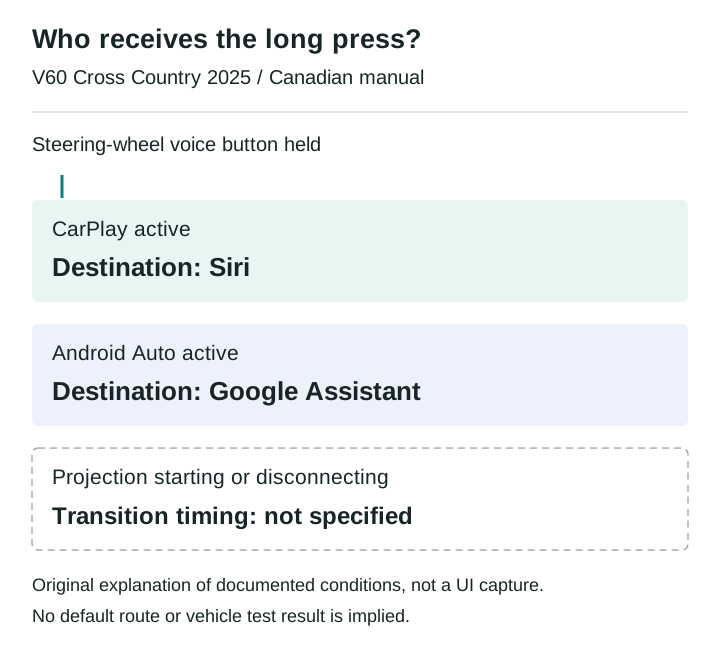
Which assistant owns the steering-wheel voice button?
The Canadian 2025 V60 Cross Country manual assigns the same long press to different phone assistants. A disconnect scenario shows what an integration test must record before judging media commands.
 02
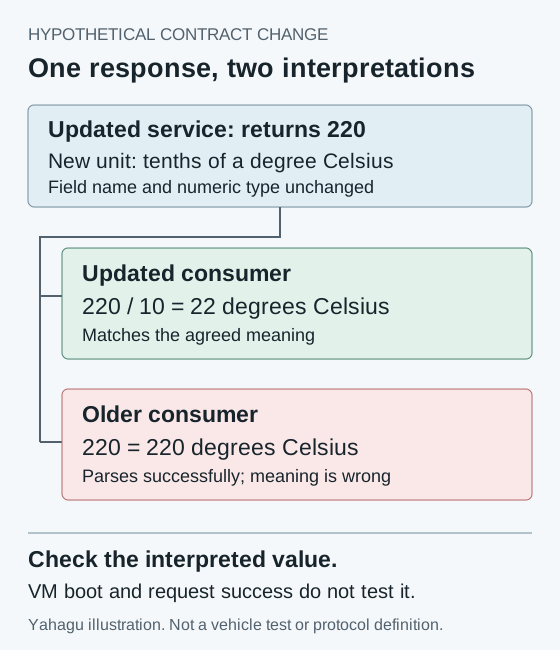
Choosing when to commit an Android SDV update
A VM can boot successfully while its consumers disagree about a changed service. A worked compatibility example explains what an integrator should verify before committing an Android SDV update.
 03
Audio focus loss is not proof of silence
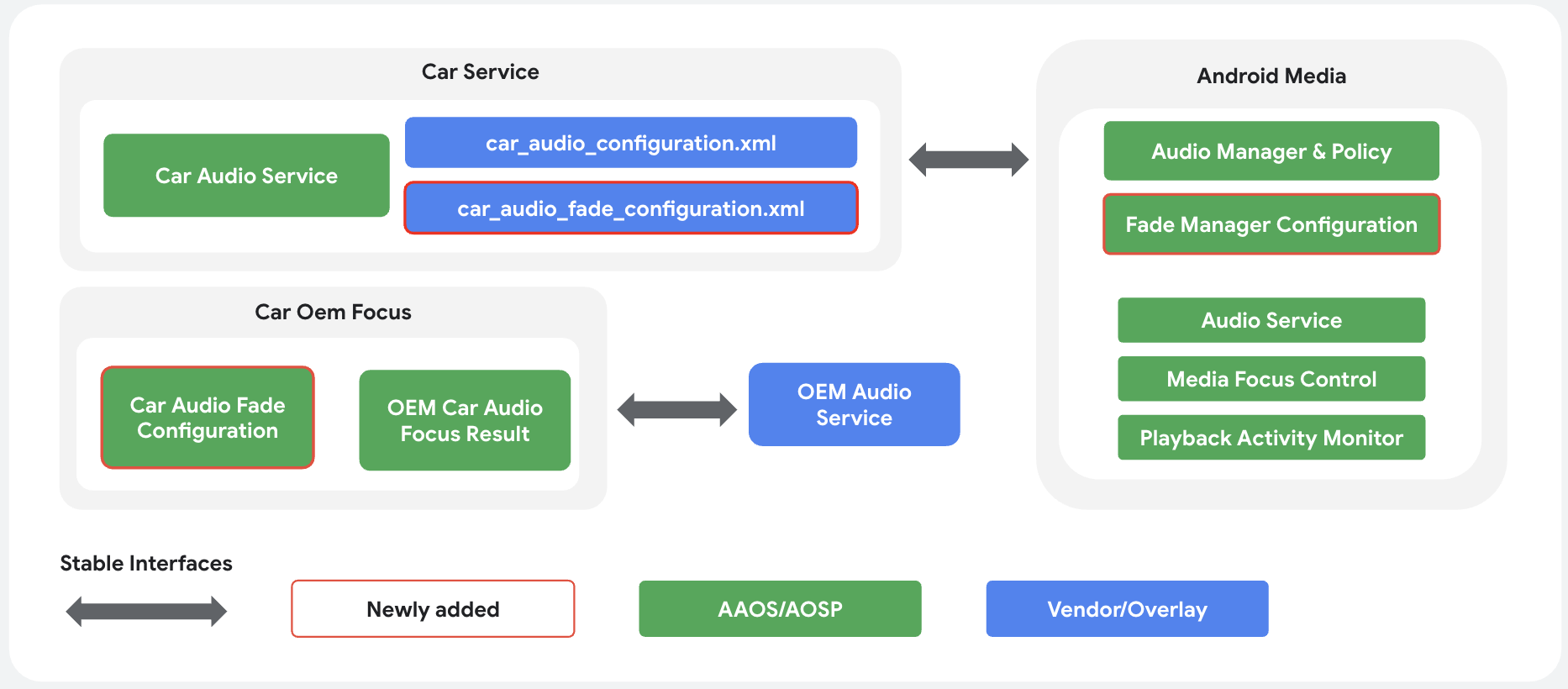
A navigation prompt interrupts music. The focus log looks correct, but it cannot tell you what reached the driver's seat. An AAOS review needs separate evidence for policy, player behavior and output.
 04
A readable temperature is not a successful climate command
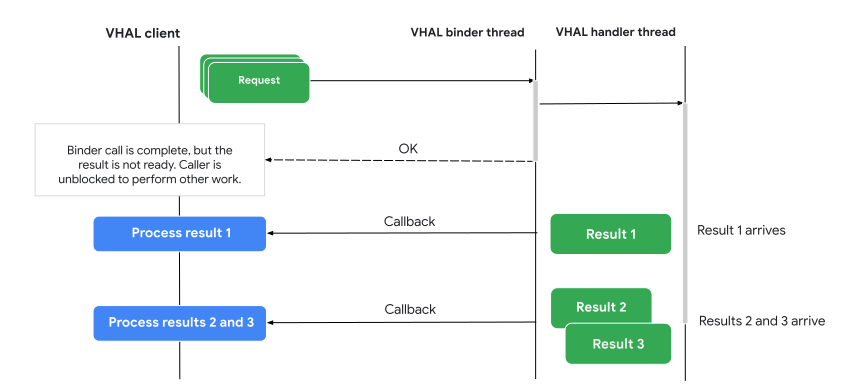
A climate control can show a valid temperature and still fail to change it. For an AAOS integration, the useful distinction is between the reported target, the pending request and the temperature the system measures.
 05
Passenger displays need their own restriction contract
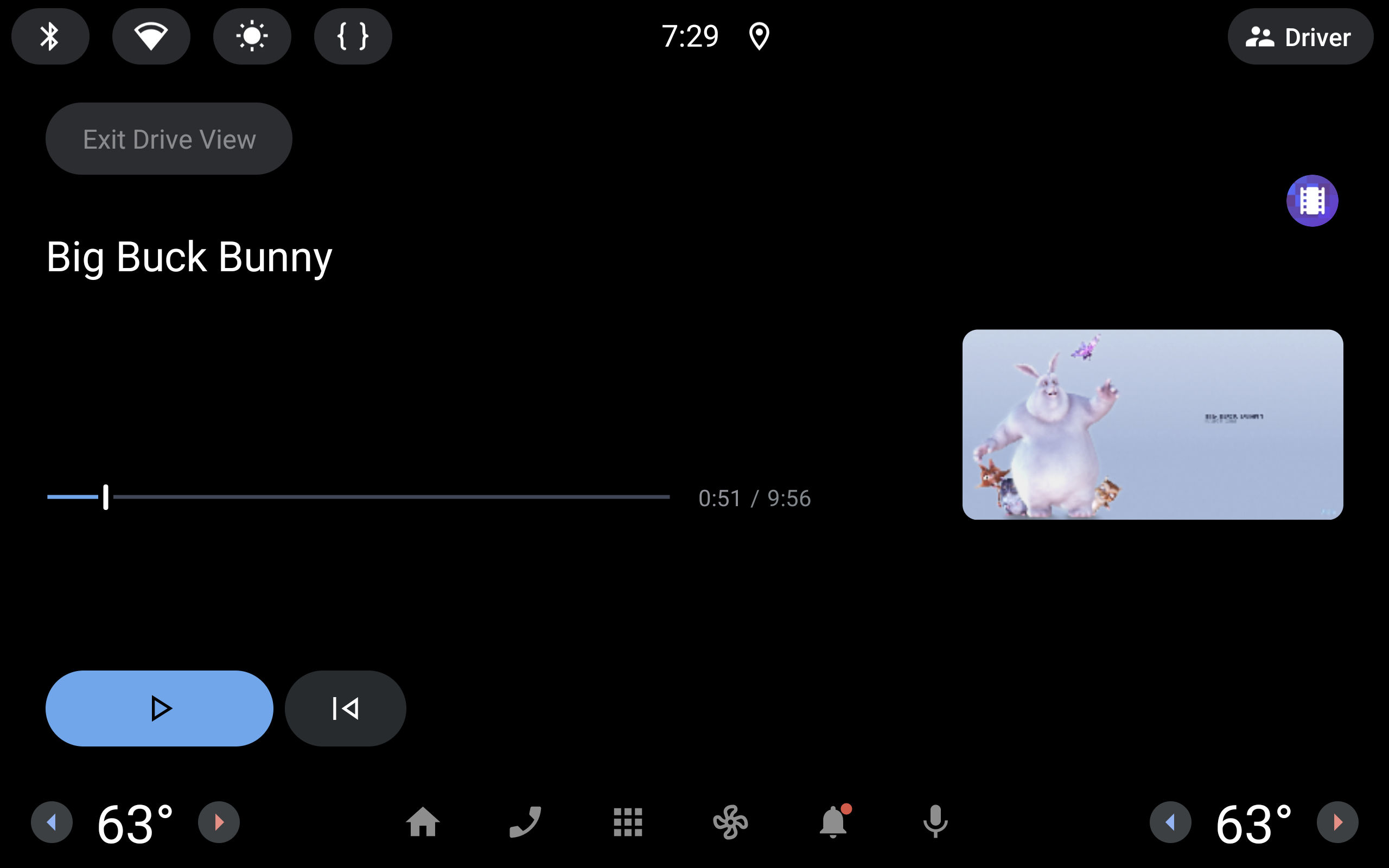
A passenger video experience cannot rely on one vehicle-wide moving flag. AAOS separates display restrictions, activity blocking and supported background audio. Here is how those boundaries change an integration review.
 06
Physical buttons still need a state model
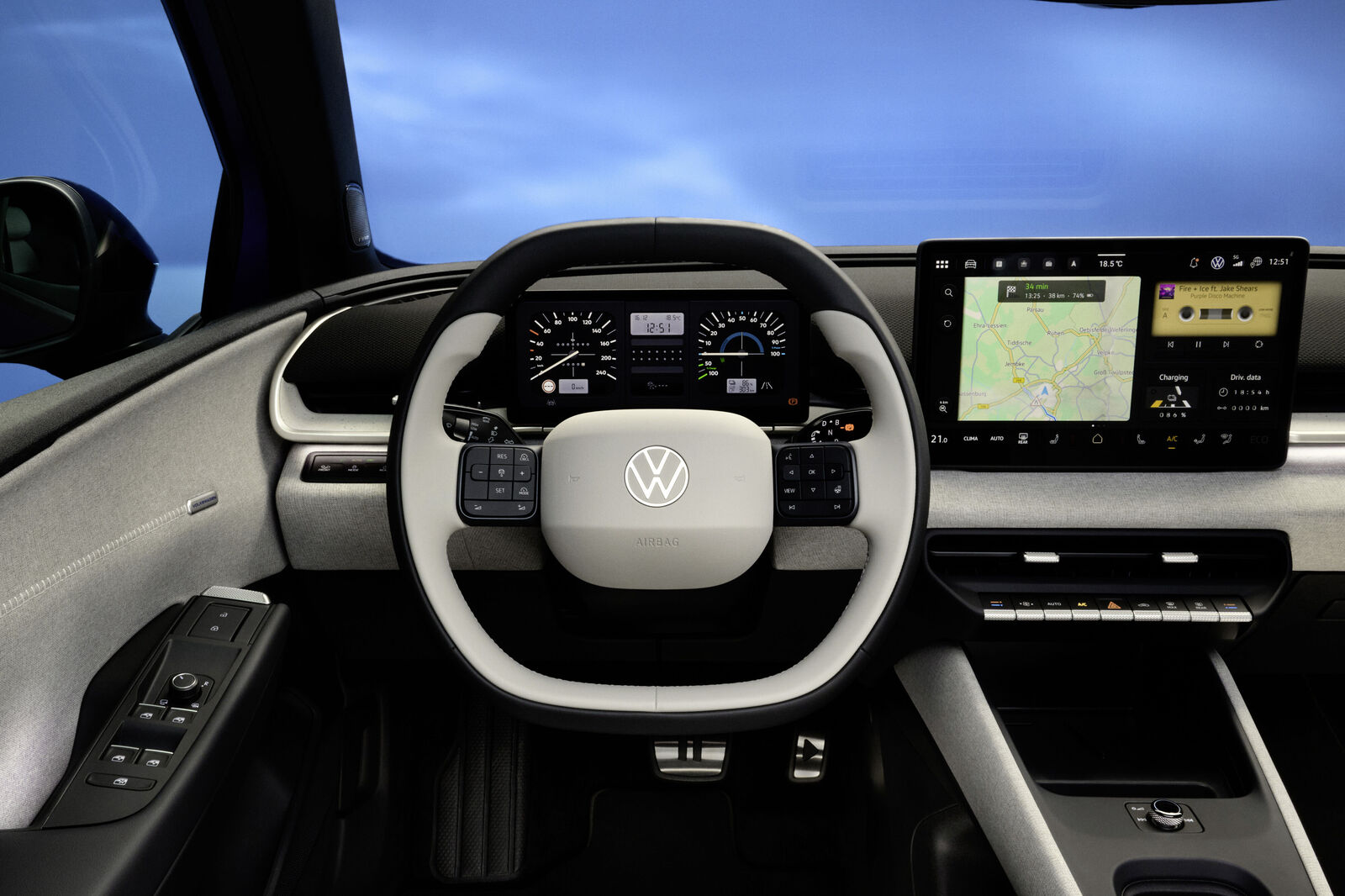
Volkswagen gives climate and audio tasks fixed locations. BMW's announced steering wheel highlights actions as they become available. An interrupted call shows why both hardware and software state belong in the review.
 07
The LYRIQ supports CarPlay. Which system plans the charging stop?
A charging trip can cross a phone planner, projected maps and built-in navigation. The useful comparison is what each path retains, recalculates and confirms before arrival.
 08
Car app sign-in: what happens after the phone says done?
The phone approves the account, but the car still needs a result. A review of parked sign-in, delayed authorization and recovery paths that send drivers back to the right task.
 09
Four screens between a saved place and turn-by-turn navigation
A close reading of Google's navigation example: where a place becomes a route, why a familiar layout still consumes another step, and what Back must preserve.